Loughborough University tool tracks online COVID-19 mental health hotspots
The tool uses bot detection and community level geospatial analysis to filter out artificial content and detect stress hotspots over time.

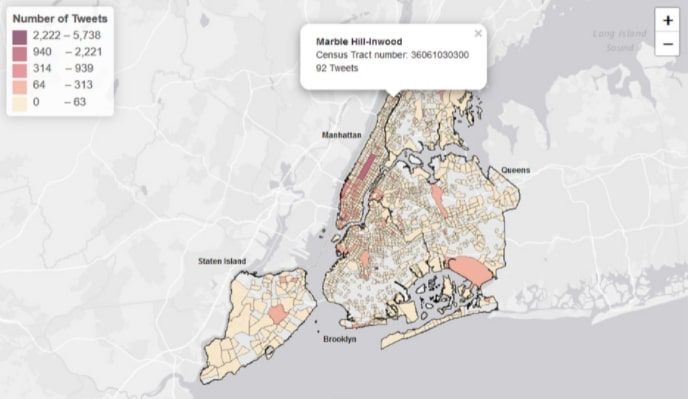
A map of New York City showing negative mood hotspots during the COVID outbreak. Pic: Loughborough University
An online Loughborough University COVID-19 tool will track and locate people's emotions on social media.
The tool uses bot detection and community level geospatial analysis to filter out artificial content while detecting stress hotspots over time.
The system prototype can detect geographical hotspots where public mental health might be suffering and allow health authorities, workers and wellbeing organisations to refocus their attention.
Dr Martin Sykora of Loughborough's School of Business and Economics said: "The mental health burden has not been felt equally and has often fallen most on those with the least means.
"While social media analytics tools are increasingly used to assess conversations around certain issues, the veracity of the content and its relation to local communities is not particularly well understood.
"Our example tool highlights some of these issues."
The details were published in the journal, Health and Place, following evidence that suggests a rise in depression, anxiety and other disorders due to the pandemic.
Social media analysis (Twitter in particular) is an effective platform for detecting mood and affective states.
But the use of data is complicated by automated social posts known as bots – computer-controlled accounts often associated with spreading fake news, conspiracy theories and promoting propaganda.
Identifying them will allow the online tool to give a more accurate picture of the public mood.
The team from Loughborough, Zurich (Switz), Boston (US), London and San Francisco (US) used online tracking tools they created to study the emotions of 34,140 tweets posted between January 1 and October 23 2020.
The tweets were from people who lived in New York.
After calculating and identifying hotspots of above-average emotions or stress, the team created a map showing geographic clusters of negative emotions linked to the spread of the coronavirus outbreak.
Dr Suzanne Elayan, also involved in the research, said: "Bots have increasingly played a role on digital platforms by skewing topics that influence existing applications and study findings, often in unknown ways.
"There's a real need to identify such 'artificial' actors and their impact, especially around localised conversations during times of crises.
"We are now conducting ongoing research work on how bots can influence and propagate emotional content on social media at scale and the impact and disparities of digital places on local communities.
"For instance, integrating socio-ecological environment information, such as employment rate, air pollution, at a low, community-level census geography."
Read the full paper here.
Get all the latest news, updates, things to do and more from Loughborough, Leicestershire's dedicated InYourArea feed.


